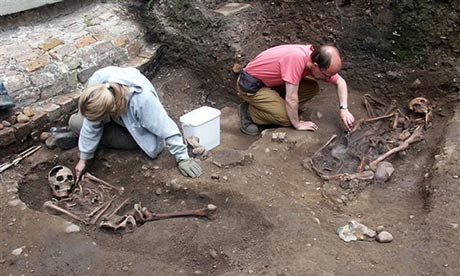
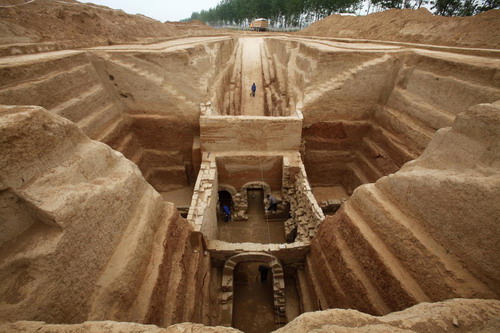
Welcome to
History Buff, a blog for history lovers everywhere! History Buff brings
news stories about archaeology from around the world together on one site.
From finds in ancient Egypt to new discoveries in anthropology, History
Buff wants to know.
# Posted by Michelle Moran @ |
Thursday, December 30, 2010
Mosaics found in SE Turkey lead to unearthing of ancient Roman city
The accidentally found mosaics led to the unearthing of the Roman-era city of Germenicia in the southeastern province of Kahramanmaraş. When the work is complete, the area will become an open-air museum.
The ancient city of Germenicia, which has been underground for 1,500 years, is being unearthed thanks to mosaics found during an illegal excavation in 2007 under a house in Southeast Turkey. Excavations are ongoing in the area, with authorities aiming to completely reveal the mosaics and the city, and then turn the site into an open-air museum.
# Posted by Michelle Moran @ |
Thursday, December 30, 2010
Ancient Egyptian Priests' Names Preserved in Pottery
By Rossella Lorenzi
Broken pieces of clay pottery have revealed the names of dozens of Egyptian priests who served at the temple of a crocodile god, Egypt's Supreme Council of Antiquities (SCA) announced.
# Posted by Michelle Moran @ |
Thursday, December 30, 2010
12.27.2010
Researchers: Ancient human remains found in Israel
by Daniel Estrin
JERUSALEM – Israeli archaeologists said Monday they may have found the earliest evidence yet for the existence of modern man, and if so, it could upset theories of the origin of humans.
# Posted by Michelle Moran @ |
Monday, December 27, 2010
12.23.2010
30,000-year-old girl's pinkie points to new early human species
(CNN) -- An overlooked female pinkie bone put in storage after it was discovered in a Siberian cave two years ago points to the existence of a previously unknown prehistoric human species, anthropologists say.
# Posted by Michelle Moran @ |
Monday, December 20, 2010
Preserving Africa’s Ancient Manuscripts
Deputy Prime Minister and Minister of Foreign Affairs Hailemariam Dessalegn said that although Africa is the poorest continent economically, it has a wealth of cultural heritage.
# Posted by Michelle Moran @ |
Monday, December 20, 2010
12.17.2010
Bones found on island might be Amelia Earhart's
NORMAN, Okla. – The three bone fragments turned up on a deserted South Pacific island that lay along the course Amelia Earhart was following when she vanished. Nearby were several tantalizing artifacts: some old makeup, some glass bottles and shells that had been cut open.
# Posted by Michelle Moran @ |
Friday, December 17, 2010
Pythagoras, a math genius? Not by Babylonian standards
by Laura Allsop
(CNN) -- Over 1,000 years before Pythagoras was calculating the length of a hypotenuse, sophisticated scribes in Mesopotamia were working with the same theory to calculate the area of their farmland.
# Posted by Michelle Moran @ |
Wednesday, December 15, 2010
12.14.2010
2,400-Year-Old Pot of Soup Found in Chinese Tomb
By Theunis Bates
Wondering what to do with those slowly molding Thanksgiving leftovers festering at the back of your fridge? Well, if you let them rot for another few thousand years, they could become an important archaeological treasure.
# Posted by Michelle Moran @ |
Tuesday, December 14, 2010
Gales unearth Roman-era statue on Israel's coast
(Reuters) - A Roman statue that had been buried for centuries has been unearthed by the winter gales that have raked Israel's coast. The white-marble figure of a woman in toga and sandals was found in the remains of a cliff that crumbled under the force of winds, waves and rain at the ancient port of Ashkelon, the Israel Antiquities Authority said on Tuesday.Read the rest here.
# Posted by Michelle Moran @ |
Tuesday, December 14, 2010
12.12.2010
The real-life Da Vinci Code: Historians discover tiny numbers and letters in the eyes of the Mona Lisa
Art historians are probing a real-life Da Vinci Code style mystery after discovering tiny numbers and letters painted into the eyes of the artist's enigmatic Mona Lisa painting.
# Posted by Michelle Moran @ |
Saturday, December 11, 2010
12.10.2010
Was Medieval England more Merrie than thought?
LONDON (Reuters) – Maybe being a serf or a villein in the Middle Ages was not such a grim existence as it seems. Medieval England was not only far more prosperous than previously believed, it also actually boasted an average income that would be more than double the average per capita income of the world's poorest nations today, according to new research.
# Posted by Michelle Moran @ |
Friday, December 10, 2010
Roman Museum Saved In Canterbury, Kent, UK
The fight to save the Roman Museum has been won thanks to public support and better marketing. Canterbury council sparked outrage last year when it said three of the city’s museums, including the Roman Museum in Butchery Lane, would have to close as part of a round of budget cuts.
# Posted by Michelle Moran @ |
Friday, December 10, 2010
12.09.2010
'Vandals have hacked at the heart of Christianity': 2,000-year-old Holy Thorn Tree of Glastonbury is cut down
Luke Salked
Standing proudly on the side of an English hill, its religious roots go back 2,000 years. But a single night of vandalism has left an ancient site of pilgrimage in splinters.
# Posted by Michelle Moran @ |
Thursday, December 09, 2010
12.07.2010
Egyptian Bones Could Help Solve Canine Conundrum
Scientists are still trying to explain how the gray wolf could evolve into over 400 breeds of dogs, ranging from the pug to the pinscher. One aid in solving this riddle has been found in an unlikely place: a giant animal shrine from ancient Egypt.
# Posted by Michelle Moran @ |
Tuesday, December 07, 2010
Heathen Buried in Iceland, 1,100 Years Post-Mortem
A burial took place in Reykjanesbaer municipality in southwest Iceland yesterday. The news wouldn’t have had any special significance if not for the fact that the person buried, an ancient heathen, passed away 1,100 years ago and the ceremony took place inside the Viking World museum.
# Posted by Michelle Moran @ |
Tuesday, December 07, 2010
Scientists Discover 'Koreaceratops': First Horned Dino From Korea
Triceratops has a new cousin -- one from a distant continent, that is. Scientists from South Korea, the United States and Japan just announced the discovery of a new horned dinosaur, based on an analysis of fossil evidence found in South Korea. Dubbed "Koreaceratops" after its country of origin, the new dinosaur fossil was found in 2008 in a block of rock along the Tando Basin reservoir.
# Posted by Michelle Moran @ |
Tuesday, December 07, 2010
12.04.2010
From Iran to Corinth – Pottery research shows Greek city engaged in long distance trade during medieval times
At the end of ancient times, Corinth, one of the most famous cities in the Greek world, lay partly in ruins. “The mid 6th century city fell victim first to bubonic plague, with high mortality levels, and subsequently a deep economic recession that lasted, according to the archaeological finds, for 500 years,” write archaeologists from the American School of Classical Studies at Athens in an overview on their website. The school has been excavating Corinth since 1896.
# Posted by Michelle Moran @ |
Saturday, December 04, 2010
2,300-Year-old Maya ruins destroyed for pastureland
Mexico City – An ancient Mayan residential complex some 2,300 years old was destroyed by heavy machinery in the southeastern Mexican state of Yucutan to clear the land for pasture on a private ranch, officials told Efe.
# Posted by Michelle Moran @ |
Saturday, December 04, 2010
12.01.2010
Italy: Another building collapses at ancient Pompeii site
Another part of the world-famous ancient Roman city of Pompeii in southern Italy has collapsed, archaeological officials at the site told Adnkronos on Tuesday. Following days of heavy rains, a section of a wall belonging to the House of the Moralist gave way, Adnkronos learned.
# Posted by Michelle Moran @ |
Wednesday, December 01, 2010
Archaeologists: Roman and Byzantine Findings Unearthed in Southern Syria
Syria (Suwaida) - The Syrian archaeological mission working at al-Gharia village unearthed nine cemeteries and a number of findings from the Byzantine and Roman eras.
# Posted by Michelle Moran @ |
Wednesday, December 01, 2010
11.29.2010
Crown Suggests Queen Arsinoë II Ruled Ancient Egypt as Female Pharaoh
ScienceDaily — A unique queen's crown with ancient symbols combined with a new method of studying status in Egyptian reliefs forms the basis for a re-interpretation of historical developments in Egypt in the period following the death of Alexander the Great. A thesis from the University of Gothenburg (Sweden) argues that Queen Arsinoë II ruled ancient Egypt as a female pharaoh, predating Cleopatra by 200 years.
# Posted by Michelle Moran @ |
Monday, November 29, 2010
Staggering Picasso trove turns up in France
By JAMEY KEATEN, Associated Press Jamey Keaten, Associated Press
PARIS – A retired French electrician and his wife have come forward with 271 undocumented, never-before-seen works by Pablo Picasso estimated to be worth at least 60 million euros ($79.35 million), an administrator of the artist's estate said Monday.
# Posted by Michelle Moran @ |
Monday, November 29, 2010
11.26.2010
More Proof That Vikings Were First to America
By Lisa Bend
Pity poor Leif Ericsson. The Viking explorer may well have been the first European to reach the Americas, but it is a certain Genoan sailor who gets all the glory. Thanks to evidence that has until now consisted only of bare archeological remains and a bunch of Icelandic legends, Ericsson has long been treated as a footnote in American history: no holiday, no state capitals named after him, no little ditty to remind you of the date of his voyage. But a group of Icelandic and Spanish scientists studying one mysterious genetic sequence — and one woman who's been dead 1,000 years — may soon change that.
# Posted by Michelle Moran @ |
Wednesday, November 24, 2010
2,000-year-old intact female skeleton with gray hair unearthed in Hubei
A 2,000-year-old intact skeleton of an elderly woman was unearthed from a tomb from the early Western Han dynasty at the construction site of an industrial park in the north of Zhuchengjie, a satellite city of Wuhan, capital of east-central China's Hubei Province, on Nov. 19.
# Posted by Michelle Moran @ |
Wednesday, November 24, 2010
11.23.2010
London's National Portrait Gallery Finds Relics of English King Richard II in Its Basement
LONDON.- An archivist at the National Portrait Gallery has found relics from the tomb of King Richard II while cataloguing the papers of its first Director Sir George Scharf (1820-1895). Among the hundreds of diaries and notebooks left behind in boxes not opened for years were contents from the coffin of a medieval English king, and sketches of his skull and bones.
# Posted by Michelle Moran @ |
Tuesday, November 23, 2010
Ancient Egyptian temple submerged in sewage
An ancient Egyptian temple to the god Ptah in the village of Meet Rahina near Memphis, just south of Cairo, now sits submerged in sewage. The temple, which was built during the reign of Pharaoh Ramses II (1279 BC - 1213 BC) and was once a major tourist attraction, now serves as a home for stray dogs. According to local residents, sanitation authorities never removed the piles of garbage dumped around the temple by villagers. Read the rest here.
# Posted by Michelle Moran @ |
Tuesday, November 23, 2010
11.22.2010
Boy, 3, uncovers $4M gold medieval relic
Forget the tricycle — your kid needs a metal detector.
James Hyatt, then 3, found $4 million worth of medieval gold on a trip with his father and grandfather while scouring the Essex countryside with their device.
# Posted by Michelle Moran @ |
Monday, November 22, 2010
Ancient Roman soldiers' bathhouse found in Jerusalem
By Shira Medding
Jerusalem (CNN) -- Israeli archaeologists have discovered an ancient Roman bathhouse that was probably used by the soldiers who destroyed the Second Temple in Jerusalem, the Israel Antiquities Authority announced Monday.
# Posted by Michelle Moran @ |
Monday, November 22, 2010
11.21.2010
Burnt City woman's face reconstructed
Rome's National Museum of Oriental Art has displayed the reconstructed face of a female skeleton which was found in Iran's Burnt City wearing an artificial eyeball. The reconstructed version of the 5,000-year-old skeleton was unveiled during a ceremony attended by head of Iran's Cultural Heritage, Handicrafts and Tourism Organization Hamid Baqaei and Iran's ambassador to Italy Seyyed Mohammad-Ali Hosseini.
# Posted by Michelle Moran @ |
Sunday, November 21, 2010
Dozer Driver Makes Fossil Discovery of the Century
by Loren Grush
An accidental discovery by a bulldozer driver has led to what may be the find of the century: an ice-age burial ground that could rival the famed La Brea tar pits. After two weeks of excavating ancient fossils at the Ziegler Reservoir near Snowmass Village, Colorado, scientists from the Denver Museum of Natural Science returned home Wednesday with their unearthed treasures in tow -- a wide array of fossils, insects and plant life that they say give a stunningly realistic view of what life was like when ancient, giant beasts lumbered across the Earth.
# Posted by Michelle Moran @ |
Sunday, November 21, 2010
11.18.2010
Ancient Roman landscape unearthed near London
London, England (CNN) -- Archaeologists have uncovered an ancient Roman landscape beneath a park in west London, with a Roman road, evidence of a settlement, and unusual burials among the finds.
# Posted by Michelle Moran @ |
Thursday, November 18, 2010
11.15.2010
16th Century Astronomer's Remains Exhumed
(CBS/AP) Astronomer Tycho Brahe uncovered some of the mysteries of the universe in the 16th century - and now modern-day scientists are delving into the mystery of his sudden death. On Monday, an international team of scientists opened his tomb in the Church of Our Lady Before Tyn near Prague's Old Town Square, where the famous Dane has been buried since 1601.
# Posted by Michelle Moran @ |
Monday, November 15, 2010
World's oldest Copper Age settlement found
A "sensational" discovery of 75-century-old copper tools in Serbia is compelling scientists to reconsider existing theories about where and when man began using metal. Belgrade - axes, hammers, hooks and needles - were found interspersed with other artefacts from a settlement that burned down some 7,000 years ago at Plocnik, near Prokuplje and 200 km south of Belgrade.
# Posted by Michelle Moran @ |
Monday, November 15, 2010
Ancient Egyptian 'Avenue of Sphinxes' gets twelve Sphinxes longer
Archaeologists have unearthed twelve ancient sphinx statues at Luxor, Egypt. The sculptures were found at a newly discovered part of the Avenue of Sphinxes, an ancient road stretching from the temple at Karnak to the temple of the goddess Mut at Luxor.Read the rest here.
# Posted by Michelle Moran @ |
Monday, November 15, 2010
11.12.2010
Fertile Crescent farmers took DNA to Germany
Rebecca Jenkins ABC
DNA evidence suggests that immigrants from the Ancient Near East brought farming to Europe, and spread the practice to the region's hunter-gatherer communities, according to Australian-led research.
# Posted by Michelle Moran @ |
Friday, November 12, 2010
Chinese vase sells for record-breaking $68M
London, England (CNN) -- A Chinese vase found during a house clearout in London has sold at auction for what is believed to be a world record £43 million ($68 million).
# Posted by Michelle Moran @ |
Friday, November 12, 2010
11.09.2010
The brains of Neanderthals and modern humans developed differently
by Max-Planck-Gesellschaft
Researcher at the Max Planck Institute for Evolutionary Anthropology in Leipzig, Germany have documented species differences in the pattern of brain development after birth that are likely to contribute to cognitive differences between modern humans and Neanderthals.
# Posted by Michelle Moran @ |
Tuesday, November 09, 2010
11.08.2010
Roman coin forged by ancient 'Del Boy'
A Roman coin discovered by a cleaner was struck by a 'Del Boy' forger who could not spell and did not know his emperors. The silver denarius, based on coins marking the Battle of Actium in 31BC, has the word ‘Egypt’ spelled incorrectly and bears the head of Emperor Caesar when it should be Augustus, British Museum experts said.
# Posted by Michelle Moran @ |
Monday, November 08, 2010
Experts reveal brutal Viking massacre
By Liam Sloan
VIKING skeletons buried beneath an Oxford college were the victims of brutal ethnic cleansing 1,000 years ago, archaeologists have discovered. Experts were mystified when they discovered a mass grave beneath a quadrangle a St John’s College, St Giles, in 2008. Read the rest here.
# Posted by Michelle Moran @ |
Monday, November 08, 2010
New Statistical Model Moves Human Evolution Back Three Million Years
ScienceDaily— Evolutionary divergence of humans and chimpanzees likely occurred some 8 million years ago rather than the 5 million year estimate widely accepted by scientists, a new statistical model suggests.
# Posted by Michelle Moran @ |
Monday, November 08, 2010
Egypt: A life before the afterlife
by Richard Parkinson
Ancient Egypt rarely escapes our stereotypical view of it: an exotic place full of pyramids crammed with cursed treasure, waiting to be discovered by adventurous archaeologists. As in René Goscinny and Albert Uderzo's comic Asterix and Cleopatra, it is often presented as a land of spooky tombs and people speaking in hieroglyphic pictures. These stereotypes are themselves quite ancient – even to the ancient Greeks, Egypt was a quintessentially different culture. But they trivialise a complex society.
# Posted by Michelle Moran @ |
Monday, November 08, 2010
Pompeiians Flash-Heated to Death—"No Time to Suffocate"
Maria Cristina Valsecchi in Rome The famous lifelike poses of many victims at Pompeii—seated with face in hands, crawling, kneeling on a mother's lap—are helping to lead scientists toward a new interpretation of how these ancient Romans died in the A.D. 79 eruptions of Italy's Mount Vesuvius. Until now it's been widely assumed that most of the victims were asphyxiated by volcanic ash and gas. But a recent study says most died instantly of extreme heat, with many casualties shocked into a sort of instant rigor mortis.Read the rest here.
# Posted by Michelle Moran @ |
Monday, November 08, 2010
11.07.2010
Ozzy Osbourne genome sequenced
Furthermore, Osbourne's got a genetic sliver that once belonged to homo sapiens' extinct cousins, the Neanderthals. "For a long time we thought that Neanderthals didn't have any descendents today, but it turns out that Asians and Europeans have some evidence of Neanderthal lineage – like a drop in the bucket," Pearson said. "We found a little segment on Ozzy's chromosome 10 that very likely traces back to a Neanderthal forebear."
# Posted by Michelle Moran @ |
Sunday, November 07, 2010
11.03.2010
Pompeii’s Mystery Horse Is a Donkey
Indeed, the identity of the strange breed of 'horse' that has been discovered in 2004, at Pompeii, has been cleared out by a Cambridge University researcher, who realized it was actually a donkey. Back in 2004, when academics unearthed skeletons found at a house in the ancient Roman town that was covered in ashes in 79 AD, they thought it belonged to an extinct breed of horse.
# Posted by Michelle Moran @ |
Wednesday, November 03, 2010
11.01.2010
Gigapan: Prehistoric Cave Art of Niaux
Deep in the mountainside near the Ariege river in France, ghostly images of long ago still dance across the rock walls of tunnels, overhangs, and vast caverns.
# Posted by Michelle Moran @ |
Monday, November 01, 2010
Old Mystic Cemetery Has Rare Wolf Stones
MYSTIC — When a young Israel Putnam climbed into a craggy den on a snowy afternoon in 1743 and killed the last wolf in Connecticut, colonists could breathe a sigh of relief.
# Posted by Michelle Moran @ |
Thursday, October 28, 2010
Early Humans' Weapon-Making Skills Sharper Than Expected
By Charles Q. Choi, LiveScience Senior Writer
A delicate, sophisticated way to craft sharp weapons from stone apparently was developed by humans more than 50,000 years sooner than had been thought.
# Posted by Michelle Moran @ |
Thursday, October 28, 2010
10.26.2010
Ancients faced dangers worse than cancer
Cairo, Egypt (CNN) -- Just imagine: a world without cancer. It's a tantalizing thought, recently floated by researchers at Manchester University in the UK.
# Posted by Michelle Moran @ |
Tuesday, October 26, 2010
Columbus crew skeletons free of syphilis
THE question of whether Christopher Columbus and his crew were responsible for bringing syphilis to Europe from the Americas appears to have been answered by the discovery of a collection of knobbly skeletons in a London cemetery, experts have revealed. Read the rest here.
# Posted by Michelle Moran @ |
Tuesday, October 26, 2010
The First Emperor's Terracotta Army recruited outside China
by Owen Jarus
Acrobats from Burma, workers from Central or West Asia, and a mausoleum design inspired by work in the Middle East – the Mausoleum of China’s First Emperor was a cosmopolitan place says Dr. Duan Qingbo, the man in charge of excavating it.
# Posted by Michelle Moran @ |
Tuesday, October 26, 2010
10.25.2010
Royal Blood May Be Hidden Inside Decorated Gourd
by Jennifer Viegas, Discovery Channel
Carved pumpkins abound this Halloween season, but a decorated gourd dated to 1793 may be the spookiest of them all. New research determines it may contain the blood of Louis XVI, who was executed by guillotine that same year.
# Posted by Michelle Moran @ |
Monday, October 25, 2010
Where Pocahontas Said, 'I Do'
Her life has been celebrated in song, story and a Disney cartoon, but no one knew where Pocahontas tied the knot with a tobacco farmer—until now. Archaeologist Bill Kelso and his team were digging this summer in a previously unexplored section of the fort at Jamestown, Va., the country's oldest permanent English colony, when they uncovered a series of deep holes.
# Posted by Michelle Moran @ |
Monday, October 25, 2010
10.24.2010
Divers discover 1500 live ammunition shells under NY bridge
by Rich Calder
COMMERCIAL divers were confident Sunday that they uncovered what the Navy missed more than 50 years ago during a frantic search that made national headlines in the US: roughly 1500 live shells that went overboard into New York's Verrazano Narrows and Gravesend Bay.
# Posted by Michelle Moran @ |
Sunday, October 24, 2010
10.22.2010
York's 'Headless Romans' (gladiators, according to some) had exotic origins and diet
They are unusual because they are all believed to be male, most are adults – and more than half had been decapitated. When these 30 bodies were buried some got their heads in the right place – on their shoulders. Others saw their heads placed between their knees, on their chests or down by their feet. In one double burial the two bodies even had had their heads swapped over.
# Posted by Michelle Moran @ |
Friday, October 22, 2010
Restoring 'lost city' of medieval Spain
Archaeologist Ramon Fernandez explains the significance of the finds
It has been 100 years since excavations started on the Madinat Al Zahra, the magnificent 10th century palace city near Cordoba in southern Spain. Although only 11% of the city - built by the powerful caliph Abd Al Rahman III - has been uncovered, it is unlikely that it will take another century to unearth the remainder of the site given the rapid advances in excavation technology.
# Posted by Michelle Moran @ |
Friday, October 22, 2010
10.20.2010
Neanderthal Children Were Large, Sturdy
Jennifer Viegas
Neanderthal youngsters that made it to the "terrible two's" were large, sturdy and toothy, suggests a newly discovered Neanderthal infant. The child almost survived to such an age, but instead died when it was just one and a half years old.
# Posted by Michelle Moran @ |
Wednesday, October 20, 2010
10.19.2010
Tomb of ancient Egyptian priest Rudj-Ka discovered at Giza
Egyptian archaeologists discovered a 4400-year-old tomb, south of the cemetery of the pyramid builders at Giza, Egypt. In a statement, Egyptian Minister of Culture Farouk Hosny, said the ancient Egyptian tomb was unearthed during routine excavations supervised by the Supreme Council of Antiquities (SCA) near the pyramid builder's necropolis.
# Posted by Michelle Moran @ |
Tuesday, October 19, 2010
2012 Mayan Calendar 'Doomsday' Date Might Be Wrong
By Ian O'Neill
According to all the ridiculous hype surrounding Dec. 21, 2012, the Mayans "predicted" the end of the world with one of their calendars. On this date, doomsayers assert that Earth will be ravaged by a smorgasbord of cataclysmic astronomical events -- everything from a Planet X flyby to a "killer" solar flare to a geomagnetic reversal, ensuring we have a very, very bad day. As we all know by now, these theories of doom are bunkum.
# Posted by Michelle Moran @ |
Tuesday, October 19, 2010
10.16.2010
Tyrannosaurus rex munched on his own kind for lunch
by Phil Gast
(CNN) -- Add cannibalism to the fearsome attributes of Tyrannosaurus rex, the big-headed dinosaur that roamed North America 66 million years ago and took no prisoners.
# Posted by Michelle Moran @ |
Saturday, October 16, 2010
Monmouth trysting place of Admiral Nelson and his mistress unearthed by archaeologists
by Darren Devine, Western Mail
ARCHAEOLOGISTS are hoping they can rebuild the summer house that provided the backdrop to an illicit romance between Britain’s greatest ever naval hero and his aristocratic mistress.
# Posted by Michelle Moran @ |
Saturday, October 16, 2010
10.15.2010
Cancer 'is purely man-made' say scientists after finding almost no trace of disease in Egyptian mummies
By Fiona Macrae
Cancer is a man-made disease fuelled by the excesses of modern life, a study of ancient remains has found. Tumours were rare until recent times when pollution and poor diet became issues, the review of mummies, fossils and classical literature found.
# Posted by Michelle Moran @ |
Friday, October 15, 2010
Dinosaur Footprint Found at NJ Construction Site
A former New Jersey high school science teacher has discovered something that would have wowed his students: a three-toed Jurassic dinosaur footprint embedded in a slab of rock at a construction site near his home.
# Posted by Michelle Moran @ |
Friday, October 15, 2010
10.14.2010
Scientists find sign cave dwellers took care of elderly
AFP:
MADRID — Scientists said Monday they had uncovered evidence suggesting cave dwellers who lived in northern Spain some 500,000 years ago took care of their elderly and infirm.
# Posted by Michelle Moran @ |
Thursday, October 14, 2010
White Horse of Uffington is a dog, claims vet
James Meikle
It is one of Britain's most-loved ancient hill figures, careering across the downland. Now vets are being urged to question whether the White Horse of Uffington was meant to be a horse at all.
# Posted by Michelle Moran @ |
Thursday, October 14, 2010
10.12.2010
Volcanoes Wiped out Neanderthals, New Study Suggests
ScienceDaily — New research suggests that climate change following massive volcanic eruptions drove Neanderthals to extinction and cleared the way for modern humans to thrive in Europe and Asia.
# Posted by Michelle Moran @ |
Tuesday, October 12, 2010
Resurrecting the Maize King
by David Freidel, Michelle Rich, and F. Kent Reilly III
For two weeks we had been tunnelling beneath the surface of the acropolis hill at the ancient Maya city of Waká in Guatemala's Petén rainforest. It was the spring of 2006, and we knew that under the surface of the acropolis was a virtual layer cake of earlier structures. The acropolis had been one of the city's enduring spiritual centers before it was abandoned around A.D. 820.
# Posted by Michelle Moran @ |
Tuesday, October 12, 2010
Jericho unveils massive ancient mosaic
By KARIN LAUB (AP)
JERICHO, West Bank — Visitors to ancient Jericho got a rare glimpse Sunday of a massive 1,200-year-old carpet mosaic measuring nearly 900 square meters (9,700 square feet), making it one of the largest in the Middle East.
# Posted by Michelle Moran @ |
Tuesday, October 12, 2010
10.11.2010
A 'Mike' found in Buffalo?
by Melissa Klein
This unfinished painting of Jesus and Mary could be a lost Michelangelo, potentially the art find of the century. But to the upstate family on whose living-room wall it hung for years, it was just "The Mike."
# Posted by Michelle Moran @ |
Monday, October 11, 2010
10.10.2010
Parisian flat containing €2.1 million painting lay untouched for 70 years
By Henry Samuel
Behind the door, under a thick layer of dusk lay a treasure trove of turn-of-the-century objects including a painting by the 19th century Italian artist Giovanni Boldini. The woman who owned the flat had left for the south of France before the Second World War and never returned.
# Posted by Michelle Moran @ |
Sunday, October 10, 2010
10.07.2010
Roman bronze helmet found in a field sells for £2.3 MILLION... eight times its estimated value
By Tamara Cohen
A rare Roman bronze helmet found in a field by a metal detecting enthusiast, sold for an astonishing £2.3 million at auction today. The immaculately preserved 2,000-year-old artefact, one of only three ever found in Britain, was discovered in a field by an unemployed graduate in his early 20s.
# Posted by Michelle Moran @ |
Thursday, October 07, 2010
10.05.2010
Neanderthals had feelings too, say York researchers
Pioneering new research by archaeologists at the University of York suggests that Neanderthals belied their primitive reputation and had a deep seated sense of compassion.
# Posted by Michelle Moran @ |
Tuesday, October 05, 2010
10.04.2010
Archaeologists find ‘mini-Pompeii’
The most well-preserved pottery from the Stone Age ever found in Norway has turned up in an unspoiled dwelling site not far from Kristiansand. The find is considered an archaeological sensation. The discovery of a “sealed” Stone Age house site from 3500 BC has stirred great excitement among archaeologists from Norway’s Museum of Cultural History at the University in Oslo. The settlement site at Hamresanden, close to Kristiansand’s airport at Kjevik in Southern Norway, looks like it was covered by a sandstorm, possibly in the course of a few hours.Read the rest here.
# Posted by Michelle Moran @ |
Monday, October 04, 2010
New images may yield Viking ships
Archaeologists think they have found two more Viking ships buried in Vestfold County south of Oslo. The biggest may be 25 metres long, larger than any found so far.
# Posted by Michelle Moran @ |
Monday, October 04, 2010
Seeking Booty, Archaeologists Dive to Blackbeard's Pirate Ship
BEAUFORT, N.C. – Archaeologists seeking ancient pirate booty are heading back to sea off North Carolina's coast -- a continuing effort to recover artifacts from the wreck believed to be Blackbeard's flagship. Read the rest here.
# Posted by Michelle Moran @ |
Monday, October 04, 2010
10.02.2010
Mummy tattoos hint at ancient Andean acupuncture
In the current Journal of Archeological Science, a team led by Maria Anna Pabst of Austria's Medical University of Graz, "describe tattoos from two body areas of a mummy from Chiribaya Alta in Southern Peru." The team looked at the tattoos on the hands and neck of the mummy using various microscopic techniques.
# Posted by Michelle Moran @ |
Saturday, October 02, 2010
Archaeologists in Egypt unearth 3,400-year-old granite statue of pharaoh
CAIRO - Archaeologists have unearthed the upper part of a double limestone statue of a powerful pharaoh who ruled nearly 3,400 years ago, Egypt's Ministry of Culture said Saturday.
# Posted by Michelle Moran @ |
Saturday, October 02, 2010
9.28.2010
Neanderthals were able to 'develop their own tools'
By Katia MoskvitchScience reporter, BBC News
Neanderthals were keen on innovation and technology and developed tools all on their own, scientists say. A new study challenges the view that our close relatives could advance only through contact with Homo sapiens.
# Posted by Michelle Moran @ |
Tuesday, September 28, 2010
9.26.2010
Stone-Age Diet Studied by Unilever in Quest for New Products, Times Says
By Nandini Sukumar
Unilever is researching the Stone Age diet with a view to new products, The Times in London reported. "We’re going to be doing interesting, cutting-edge science but it has a hard business nose too,” Mark Berry, the Unilever scientist leading the project told the Times. Read the rest here.
# Posted by Michelle Moran @ |
Sunday, September 26, 2010
9.24.2010
French scientists discover new Sumerian temple in southern Iraq
By Khayoun Saleh
The Antiquities Department says French archaeologists have recently unearthed a new Sumerian temple in the southern Province of Dhiqar.
# Posted by Michelle Moran @ |
Friday, September 24, 2010
9.22.2010
Apollo discovery tells a new story
A rare bronze signet ring with the impression of the face of the Greek sun god, Apollo, has been discovered at Tel Dor, in northern Israel, by University of Haifa diggers. “A piece of high-quality art such as this, doubtlessly created by a top-of-the-line artist, indicates that local elites developing a taste for fine art and the ability to afford it were also living in provincial towns, and not only in the capital cities of the Hellenistic kingdoms,” explains Dr. Ayelet Gilboa, Head of the Department of Archaeology at the University of Haifa, who headed the excavations at Dor along with Dr. Ilan Sharon of the Hebrew University of Jerusalem.
# Posted by Michelle Moran @ |
Wednesday, September 22, 2010
Cambridge dig looking for Anglo-Saxon skeletons finds Roman settlement
A dig in search of Anglo-Saxon skeletons has instead unearthed signs of a sprawling Roman settlement. The discovery was made last week, on the grounds of Cambridge's Newnham College.
# Posted by Michelle Moran @ |
Wednesday, September 22, 2010
Scientists find new dinosaurs related to Triceratops
Fossils of two new species of horned dinosaurs closely related to the Triceratops have been discovered in southern Utah, scientists revealed Wednesday.
# Posted by Michelle Moran @ |
Wednesday, September 22, 2010
9.20.2010
Big noses, curly hair on empress's coffin suggests deep cultural exchange on Silk Road
Chinese archeologists have found new evidence of international cultural exchange on the ancient Silk Road. Four European-looking warriors and lion-like beasts are engraved on an empress's 1,200-year-old stone coffin that was unearthed in Shaanxi Province, in northwestern China.
# Posted by Michelle Moran @ |
Monday, September 20, 2010
Ceremonial Temples 4,000 Years Old Found in Peruvian Jungle
LIMA – A team of Peruvian archaeologists have discovered two ceremonial temples more than 4,000 years old in Peru’s northern jungle, which makes them the most ancient in the country and identifies them with the Bracamoros culture, the daily El Comercio said on Saturday.
# Posted by Michelle Moran @ |
Friday, September 17, 2010
Iron Age village found at UK school building site
LONDON (Reuters Life!) - Ancient human infant and animal remains believed to be more than 2,000 years old have been unearthed during the construction of a school in London. Archaeologists say the discovery, one of the most important in the British capital in recent years, points to evidence of an Iron Age and early Roman farming settlement.
# Posted by Michelle Moran @ |
Friday, September 17, 2010
9.16.2010
Home of "Ice Giants" thaws, shows pre-Viking hunts
By Alister Doyle, Environment Correspondent
JUVFONNA, Norway (Reuters) - Climate change is exposing reindeer hunting gear used by the Vikings' ancestors faster than archaeologists can collect it from ice thawing in northern Europe's highest mountains. "It's like a time machine...the ice has not been this small for many, many centuries," said Lars Piloe, a Danish scientist heading a team of "snow patch archaeologists" on newly bare ground 1,850 meters (6,070 ft) above sea level in mid-Norway.
# Posted by Michelle Moran @ |
Thursday, September 16, 2010
New finds suggest Romans won big North Germany battle
Berlin - New finds at a well-preserved ancient battlefield in the north of Germany are not only rewriting geo-political history, but also revealing some of the secrets of Rome's military success.
# Posted by Michelle Moran @ |
Thursday, September 16, 2010
9.14.2010
Weird Guy With Metal Detector Now Rich Weird Guy: Amateur Digs Up $460,000 Helmet
by Miral Sattar
It's almost like winning the lottery, but better! An amateur treasure hunter has unearthed a Roman helmet and mask valued at $460,000. The helmet is the third of its kind to be ever found in England. The Guardian reports that the helmet might bid for as high as $650,000 at the Christie's auction in October.
# Posted by Michelle Moran @ |
Tuesday, September 14, 2010
9.13.2010
Nara tomb said that of seventh century empress
NARA (Kyodo) An ancient tomb in Asuka, Nara Prefecture, has been identified as that of a reigning empress and her daughter built in the seventh century, as an octagonal stone paving was newly discovered, researchers at the local education board said Thursday.
# Posted by Michelle Moran @ |
Monday, September 13, 2010
In 'Canyon of the Crescent Moon,' 2,000-Year-Old Paintings Re-Emerge
Conservation experts almost gave up when they first saw the severely damaged wall paintings they had come to rescue in the ancient city of Petra -- a site made famous in the final scene in the film, "Indiana Jones and the Last Crusade."
# Posted by Michelle Moran @ |
Monday, September 13, 2010
Rare Roman suit of armour found at Caerleon dig
Archaeologists digging at a site in south Wales have uncovered an entire suit of Roman armour and some weapons. The rare discovery was made during an excavation at the fortress of Caerleon in south Wales, one of Britain's best known Roman sites.
# Posted by Michelle Moran @ |
Monday, September 13, 2010
9.10.2010
Terracotta army emerges in its true colors
by Ma Lie
China-Germany alliance has helped keep the glow on warriors' cheeks. Ma Lie reports from Xi'an.The earth in the ancient city of Xi'an continues to astound archaeologists.When excavation work to find more terracotta relics restarted for the third time last year in Xi'an, archaeologists admitted they did not expect to make any groundbreaking discoveries.
# Posted by Michelle Moran @ |
Friday, September 10, 2010
Modern Science Reveals Secrets of 2,500-year-old Mummy
KANSAS CITY, Mo -- A powerful image of the face of a 2,500-year-old Egyptian mummy at The Nelson-Atkins Museum of Art has been created by special agents/forensic artists from the federal Bureau of Alcohol, Tobacco, Firearms and Explosives (ATF), as unveiled today at the Museum.
# Posted by Michelle Moran @ |
Friday, September 10, 2010
2000-year-old pills found in Greek shipwreck
By Shanta Barley
In 130 BC, a ship fashioned from the wood of walnut trees and bulging with medicines and Syrian glassware sank off the coast of Tuscany, Italy. Archaeologists found its precious load 20 years ago and now, for the first time, archaeobotanists have been able to examine and analyse pills that were prepared by the physicians of ancient Greece.
# Posted by Michelle Moran @ |
Friday, September 10, 2010
9.08.2010
Saxon boat uncovered in Norfolk's River Ant
A Saxon boat has been found during flood defence work on a Norfolk river. The boat, which is about 9.8 ft (3m) long and had been hollowed out by hand from a piece of oak, was found at the bottom of the River Ant.
# Posted by Michelle Moran @ |
Wednesday, September 08, 2010
New Clue to How Last Ice Age Ended
ScienceDaily — As the last ice age was ending, about 13,000 years ago, a final blast of cold hit Europe, and for a thousand years or more, it felt like the ice age had returned. But oddly, despite bitter cold winters in the north, Antarctica was heating up. For the two decades since ice core records revealed that Europe was cooling at the same time Antarctica was warming over this thousand-year period, scientists have looked for an explanation.
# Posted by Michelle Moran @ |
Wednesday, September 08, 2010
9.07.2010
Prehistoric baby sling 'made our brains bigger'
By David Keys, Archaeology Correspondent
The most important aspect of human evolution was facilitated not by Darwinian-style natural selection but by a crucial technological device invented by early Stone Age women, shows research by a leading British prehistorian.
# Posted by Michelle Moran @ |
Tuesday, September 07, 2010
Prehistoric bone hats found in Inner Mongolia
Recently, archaeologists found prehistoric hats of human beings who lived 4,600 years ago from an ancient tomb site at Tongliao City of Inner Mongolia. Experts said it was the first time this kind of hats, which were made from bones, have been found in the same period of prehistoric culture.
# Posted by Michelle Moran @ |
Tuesday, September 07, 2010
9.06.2010
Researchers offer alternate theory for found skull's asymmetry
University Park, Pa. -- A new turn in the debate over explanations for the odd features of LB1 -- the specimen number of the only skull found in Liang Bua Cave on the Indonesian island of Flores and sometimes called "the hobbit" -- is further evidence of a continued streak of misleading science regarding the development of a new species, according to researchers.
# Posted by Michelle Moran @ |
Monday, September 06, 2010
Egyptian papyrus found in ancient Irish bog
The papyrus in the lining of the Egyptian-style leather cover of the 1,200-year-old manuscript, "potentially represents the first tangible connection between early Irish Christianity and the Middle Eastern Coptic Church", the Museum said.
# Posted by Michelle Moran @ |
Monday, September 06, 2010
Oval Office rug gets history wrong
By Jamie Stiehm
A mistake has been made in the Oval Office makeover that goes beyond the beige. President Obama's new presidential rug seemed beyond reproach, with quotations from Abraham Lincoln, Theodore Roosevelt, Franklin Roosevelt, John F. Kennedy and the Rev. Martin Luther King Jr. woven along its curved edge.
# Posted by Michelle Moran @ |
Monday, September 06, 2010
9.03.2010
World's 'oldest beer' found in shipwreck
(CNN) -- First there was the discovery of dozens of bottles of 200-year-old champagne, but now salvage divers have recovered what they believe to be the world's oldest beer, taking advertisers' notion of 'drinkability' to another level.
# Posted by Michelle Moran @ |
Friday, September 03, 2010
Palaeolithic funeral feast unearthed in Northern Israel
By Katie AlcockScience reporter, BBC News
The remains of a huge 12,000 year old feast have been found in a cave in Northern Israel. Archaeologists working in Hilazon Tachtit found what they thought was a late Palaeolithic campsite, when they discovered tools and animal bones.
# Posted by Michelle Moran @ |
Friday, September 03, 2010
Scalpels and skulls point to Bronze Age brain surgery
At an early Bronze Age settlement called Ikiztepe, in the Black Sea province of Samsun in Turkey. The village was home to about 300 people at its peak, around 3200 to 2100 BC. They lived in rectangular, single-storey houses made of logs, which each had a courtyard and oven in the front.
# Posted by Michelle Moran @ |
Friday, September 03, 2010
Highest-Paid Athlete Hailed From Ancient Rome
by Rosella Lorenzi
Ultra millionaire sponsorship deals such as those signed by sprinter Usain Bolt, motorcycle racer Valentino Rossi and tennis player Maria Sharapova, are just peanuts compared to the personal fortune amassed by a second century A.D. Roman racer, according to an estimate published in the historical magazine Lapham's Quarterly.
# Posted by Michelle Moran @ |
Friday, September 03, 2010
8.31.2010
Foreign religions grew rapidly in the 1st-century A.D. Roman Empire, including worship of Jesus Christ, the Egyptian goddess Isis, and an eastern sun
by Carly Silver
Of the religions that expanded rapidly in the 1st-century Roman Empire, worship of Mithras was particularly popular among Roman soldiers, who spread his cult during their far-flung travels.
# Posted by Michelle Moran @ |
Tuesday, August 31, 2010
Israel archeologists uncover 2,000-year-old cupid in City of David dig
Israeli archeologists unveiled a 2,000 year old semi-precious cameo bearing the image of Cupid on Monday, which the Israel Antiquities Authorities (IAA) said was among several items located in the City of David archeological area in Jerusalem's Old City in the last 12 months.
# Posted by Michelle Moran @ |
Tuesday, August 31, 2010
8.30.2010
Archaeologists find new clues why the Maya left
By Dan Vergano, USA TODAY
YUCATAN, Mexico— Bird calls ring from the forest, echoing amid the crumbling ruins whose darkened doorways have long beckoned explorers and scholars. The Maya ancients who built the ruins of Kiuic (kee-week) here fled those doorways in a hurry, an international archaeology team now realizes. Left behind may be frozen-in-time clues to the fabled collapse of their civilization.
# Posted by Michelle Moran @ |
Monday, August 30, 2010
Acoustic archaeology: The secret sounds of Stonehenge
by Trevor Cox
Just after sunrise on a misty spring morning last year, my fellow acoustician at the University of Salford, Bruno Fazenda, and Rupert Till of the University of Huddersfield, UK, could be found wandering around Stonehenge popping balloons. This was not some bizarre pagan ritual. It was a serious attempt to capture the "impulse response" of the ancient southern English stone circle, and with it perhaps start to determine how Stonehenge might have sounded to our ancestors.
# Posted by Michelle Moran @ |
Monday, August 30, 2010
Archeologists Find Gateway to the Viking Empire
By Matthias Schulz
For a century, archeologists have been looking for a gate through a wall built by the Vikings in northern Europe. This summer, it was found. Researchers now believe the extensive barrier was built to protect an important trading route.
# Posted by Michelle Moran @ |
Monday, August 30, 2010
8.26.2010
What have the Romans ever done for us (socks and sandals excepted)?
by Jonathan Brown
They gave the world decent roads, indoor plumbing and some of the goriest spectator sports known to man, but now it appears that the Romans made a hitherto secret contribution to global civilisation by pioneering the wearing of socks with sandals.
# Posted by Michelle Moran @ |
Thursday, August 26, 2010
Mayan pool in the rainforest
Since 2009, researchers from Bonn and Mexico have been systematically uncovering and mapping the old walls of Uxul, a Mayan city. "In the process, we also came across two, about 100 m square water reservoirs," explained Iken Paap, who directs the project with Professor Dr. Nikolai Grube and the Mexican archaeologist Antonio Benavides Castillo.
# Posted by Michelle Moran @ |
Wednesday, August 25, 2010
8.24.2010
24 August 410: the date it all went wrong for Rome?
by David Willey
Tuesday marks the 1,600th anniversary of one of the turning points of European history - the first sack of Imperial Rome by an army of Visigoths, northern European barbarian tribesmen, led by a general called Alaric.
# Posted by Michelle Moran @ |
Tuesday, August 24, 2010
8.23.2010
Discovery of ancient cave paintings in Petra stuns art scholars
by Dalya Alberge Detail of a winged child playing the flute, before and after cleaning. Photograph: Courtesy of the Courtauld Institute
Spectacular 2,000-year-old Hellenistic-style wall paintings have been revealed at the world heritage site of Petra through the expertise of British conservation specialists. The paintings, in a cave complex, had been obscured by centuries of black soot, smoke and greasy substances, as well as graffiti.
# Posted by Michelle Moran @ |
Monday, August 23, 2010
Dig unearths insight into life before the Romans
by Jay Moreno
The Big Dig 2010 at Brading Roman Villa. Picture by Robin Crossley.
THE third phase of the Big Dig at Brading Roman Villa may well have been one of the toughest excavations eminent archaeologist Sir Barry Cunliffe had ever undertaken but it has yielded some treasures and a greater understanding of Brading’s history up to its Roman occupation.
# Posted by Michelle Moran @ |
Friday, August 20, 2010
Disease killed soldiers from Oliver Cromwell’s army discovered in Fishergate
Mark Stead
ARCHAEOLOGISTS have revealed how they discovered more than they bargained for when a York excavation unearthed the remains of a “forgotten” army’s soldiers.
# Posted by Michelle Moran @ |
Friday, August 20, 2010
8.18.2010
Did Boudica live near Norwich?
DAN GRIMMER
Dr Will Bowden with the skeleton discovered at Caistor St Edmund during the last excavations.
Archaeologists are set to unearth further secrets of a Roman town on the outskirts of Norwich - and are hoping to discover evidence linking the settlemt to East Anglia's Iceni queen Boudica.
# Posted by Michelle Moran @ |
Wednesday, August 18, 2010
'Mitochondrial Eve': Mother of All Humans Lived 200,000 Years Ago
ScienceDaily — The most robust statistical examination to date of our species' genetic links to "mitochondrial Eve" -- the maternal ancestor of all living humans -- confirms that she lived about 200,000 years ago. The Rice University study was based on a side-by-side comparison of 10 human genetic models that each aim to determine when Eve lived using a very different set of assumptions about the way humans migrated, expanded and spread across Earth.
# Posted by Michelle Moran @ |
Wednesday, August 18, 2010
Statues older, more numerous than terracotta warriors found in Hunan
A large cache of ancient stone statues outnumbering the Qin Terracotta Warriors was found in the depths of the Nanling Mountains located in Dao County of Yongzhou City, according to the Xiang Gan Yue Gui Archeology Summit Forum held in Yongzhou, Hunan Province on Aug. 17.
# Posted by Michelle Moran @ |
Tuesday, August 17, 2010
Mysteries Abound in WTC Ship Remains
by James Williams
On July 12 the remains of an 18th-century ship were found buried 20 feet below street level at the site of the World Trade Center in New York City. The question is -- how did they get there?
# Posted by Michelle Moran @ |
Tuesday, August 17, 2010
Ancient temple complex discovered near Le Mans
by Pierre Le Hir
Excavations near the antique city of Vindunum (now Le Mans) have revealed a vast religious site dating from the first to the third centuries AD with remarkably well-preserved offerings.
# Posted by Michelle Moran @ |
Tuesday, August 17, 2010
8.16.2010
Archaeologists Discover the Tomb of a Teenager Buried for Over 1600 Years
LIMA.- Archaeologists have discovered, 16 meters from the tomb of the Great Lord of Sipan, the remains of a teenager belonging to the Moche society who was buried over 1600 years ago in Peru.
# Posted by Michelle Moran @ |
Monday, August 16, 2010
Archaeologists uncover egg from 9th-century Great Moravia
Hradiste - Czech archaeologists were surprised at uncovering an unharmed hen´s egg at the burial site of Hradiste, a 9th-century Great Moravia settlement, chief researcher Bohuslav Klima has told CTK.
# Posted by Michelle Moran @ |
Monday, August 16, 2010
8.13.2010
Tool Use by Early Humans Started Much Earlier
Jennifer Viegas
Fossilized bones scarred by hack marks reveal that our human ancestors were using stone tools and eating meat from large mammals nearly a million years earlier than previously thought, according to a new study that pushes back both of these human activities to roughly 3.4 million years ago.
# Posted by Michelle Moran @ |
Friday, August 13, 2010
"Thor's Hammer" Found in Viking Graves
Kate Ravilious in York, U.K.
Long dismissed as accidental additions to Viking graves, prehistoric "thunderstones"—fist-size stone tools resembling the Norse god Thor's hammerhead—were actually purposely placed as good-luck talismans, archaeologists say.
# Posted by Michelle Moran @ |
Friday, August 13, 2010
Ancient Phoenician City 'Relocated'
by Clara Moskowitz
The site of an ancient city called Aüza, the earliest African city of the Phoenician civilization that existed 3,500 years ago, may have been in a different spot than experts have thought, archaeologists report.
# Posted by Michelle Moran @ |
Friday, August 13, 2010
6.17.2010
Bones confirmed as those of Saxon Princess Eadgyth
Bones excavated in Magdeburg Cathedral in 2008 are those of Saxon Princess Eadgyth who died in AD 946, experts at the University of Bristol confirmed today. The crucial scientific evidence came from the teeth preserved in the upper jaw. The bones are the oldest surviving remains of an English royal burial.
# Posted by Michelle Moran @ |
Thursday, June 17, 2010
6.12.2010
HISTORY BUFF IS GOING ON VACATION!
It's vacation time again, so I won't be able to update the blog until August 15th. I hope everyone has a WONDERFUL summer. And happy travels for all of you on the move :)
# Posted by Michelle Moran @ |
Saturday, June 12, 2010
6.11.2010
Archaeologists unearthed 99 Greco-roman artefacts in Egypt
by Mohammed Almasri
Egypt (Abu Qir) - Ninety-nine Sunken pieces of antiquities were salvaged by the European marine archaeological institute mission in association with the Supreme Council of Antiquities (SCA) in the areas of Eastern Port and Heracleum in Abu Qir.
# Posted by Michelle Moran @ |
Friday, June 11, 2010
Crocodile and Hippopotamus Served as 'Brain Food' for Early Human Ancestors
ScienceDaily — Your mother was right: Fish really is "brain food." And it seems that even pre-humans living as far back as 2 million years ago somehow knew it.
# Posted by Michelle Moran @ |
Friday, June 11, 2010
Prehistoric pet? Dog burial found in O.C.
by Pat Brennan
It might have been a treasured pet, or the victim of traditional destruction of property after its owner's death. The reason for its burial remains a mystery.
# Posted by Michelle Moran @ |
Wednesday, June 09, 2010
6.08.2010
Ancient bees found in Israel hailed from Turkey
The origin of insects found in clay beehives in the Jordan Valley, the oldest known commercial beekeeping facility in the world, suggests extensive trading and complicated agriculture 3,000 years ago.
# Posted by Michelle Moran @ |
Tuesday, June 08, 2010
Roman gladiator cemetery found in England
London, England (CNN) -- Heads hacked off, a bite from a lion, tiger or bear, massive muscles on massive men -- all clues that an ancient cemetery uncovered in northern England is the final resting place of gladiators, scientists have announced after seven years of investigations.
# Posted by Michelle Moran @ |
Tuesday, June 08, 2010
6.07.2010
Building found during Rochester Cathedral excavation
Archaeologists digging at a cathedral in Kent have unearthed evidence of a previously unknown building. An excavation project was started at Rochester Cathedral to conserve a Roman city wall.
# Posted by Michelle Moran @ |
Monday, June 07, 2010
Researchers: Cavemen feasted on lions
Waiting in line at the drive-through may be a drag, but it sure beats what our ancestors had to do for fast food. Try take-out lion. A Spanish team reports Neanderthals likely hunted and ate a big cat at a cave site.
# Posted by Michelle Moran @ |
Monday, June 07, 2010
Scars from lion bite suggest headless Romans found in York were gladiators
Martin Wainwright Kurt Hunter-Mann, right, examines a skeleton at the site in York, which may be the only well-preserved Roman gladiator cemetery. Photograph: C4 Picture/PA
The haunting mystery of Britain's headless Romans may have been solved at last, thanks to scars from a lion's bite and hammer marks on decapitated skulls.
# Posted by Michelle Moran @ |
Monday, June 07, 2010
6.04.2010
Signs of Amelia Earhart's Final Days?
By Rossella Lorenzi
Tantalizing new clues are surfacing in the Amelia Earhart mystery, according to researchers scouring a remote South Pacific island believed to be the final resting place of the legendary aviatrix.
# Posted by Michelle Moran @ |
Friday, June 04, 2010
6.02.2010
The prophet of science: 17th century chemist who foresaw the hi-tech future
Beth Hale
They may appear to be marvels of modern science. But organ transplants, satellite navigation and cosmetic surgery can actually be traced back - in idea form at least - to a 17th century scientist with a big imagination.
# Posted by Michelle Moran @ |
Wednesday, June 02, 2010
Jamestown settlers' trash confirms hard times
by Sid Perkins
Oyster shells excavated from a well in Jamestown, Va., the first permanent British settlement in North America, bolster the notion that the first colonists suffered an unusually deep and long-lasting drought.
# Posted by Michelle Moran @ |
Wednesday, June 02, 2010
Florentine Codex, Great Intellectual Enterprise of 16th Century
MEXICO CITY.- Created under the orders of Bernardino de Sahagun by 20 tlacuilos or painters and 4 Indigenous masters, Florentine Codex is one of the greatest expressions of the Renascence in America.
# Posted by Michelle Moran @ |
Wednesday, June 02, 2010
6.01.2010
The Skull of Doom
By Jane MacLaren Walsh
Crystal skulls have long had a fringe following, and the most famous of them is one named for the explorer-author Frederick A. Mitchell-Hedges (see “Legend of the Crystal Skulls”). Mitchell-Hedges claimed to have found the skull somewhere in Central America in the 1930s, but his adopted daughter Anna later said she found it under a fallen altar or inside a pyramid at the Maya site of Lubaantún in British Honduras (now Belize) some time in the 1920s. Neither of their contradictory accounts is true. In fact, like all the other crystal skulls thus far examined, it is a modern creation, despite its nearly mythical place in the minds of devotees.
# Posted by Michelle Moran @ |
Tuesday, June 01, 2010
Jordan Valley - cradle of civilisations?
By Taylor Luck
AMMAN - Archaeological finds in the northern Jordan Valley are forcing experts to rethink the patterns of the earliest civilisations. In Tabqat Fahel, 90 kilometres north of Amman, recent finds indicate that the ancient site of Pella, which spans across the earliest pre-historic times to the Mameluke era, may have been a part of the cradle of civilisations. Read the rest on the Jordan Times.
# Posted by Michelle Moran @ |
Tuesday, June 01, 2010
Secrets of ancient Scottish hunters revealed by camp
by Chris Watt
It was an age when reindeer roamed the Scottish landscape, competing for territory with human raiding parties from what is now the North Sea. The country lay under glaciers as far south as the Highland Line, and a mini ice-age was fast approaching.
# Posted by Michelle Moran @ |
Tuesday, June 01, 2010
Advanced Technique, RTI, Used to Decipher Maya Glyphs
MEXICO CITY.- As part of most recent studies at Tonina Archaeological Zone, in Chiapas, a technique known as RTI (Reflection Transformation Imaging) is being applied for the first time in Mexico on Maya sculptures, with the aim of documenting the ancient monuments and having more details of inscriptions.
# Posted by Michelle Moran @ |
Tuesday, June 01, 2010
Tools show ancient human diet
Almost two million years ago, early humans began eating food such as crocodiles, turtles and fish – a diet that could have played an important role in the evolution of human brains and our footsteps out of Africa, according to new research.
# Posted by Michelle Moran @ |
Tuesday, June 01, 2010
Neanderthal man was living in Britain 40,000 years earlier than thought
Francis Wenban-Smith from the University of Southampton discovered two ancient flint hand tools used to cut meat at the M25/A2 road junction at Dartford, Kent, during an excavation funded by the Highways Agency.
# Posted by Michelle Moran @ |
Tuesday, June 01, 2010
World War Two bomb explodes in Germany, three dead
BERLIN, June 1 (Reuters) - A World War Two bomb found in central Germany exploded on Tuesday, killing three people, as disposal experts were about to defuse it, local authorities said.
# Posted by Michelle Moran @ |
Tuesday, June 01, 2010
5.30.2010
Archaeologists discover 13th century BC 'lost tomb' of ancient Egyptian capital's mayor
CAIRO (AP) — Archaeologists have discovered the 3,300-year-old tomb of the ancient Egyptian capital's mayor, whose resting place had been lost under the desert sand since 19th century treasure hunters first carted off some of its decorative wall panels, officials announced Sunday.
# Posted by Michelle Moran @ |
Sunday, May 30, 2010
5.27.2010
A Magnificent Pagan Altar was Exposed at the Barzilai Hospital Compound
JERUSALEM.- The development work for the construction of a fortified emergency room at Barzilai Hospital, which is being conducted by a contractor carefully supervised by the Israel Antiquities Authority, has unearthed a new and impressive find: a magnificent pagan altar dating to the Roman period (first-second centuries CE) made of granite and adorned with bulls’ heads and a laurel wreaths. The altar stood in the middle of the ancient burial field.
# Posted by Michelle Moran @ |
Thursday, May 27, 2010
5.26.2010
English Civil War battlefield 'may be in wrong place'
A monument marking an official battle site in the Cotswolds might be in the wrong place, historians have claimed. The memorial to the Stow-on-the Wold battle stands about three miles (4.8km) north-west of the town, on a hill outside Donnington.
# Posted by Michelle Moran @ |
Wednesday, May 26, 2010
Virtual Romanesque Monuments Being Created
ScienceDaily— Researchers from the Cartif Foundation and the University of Valladolid have created full color plans in 3-D of places of cultural interest, using laser scanners and photographic cameras. The technique has been used to virtually recreate five churches in the Merindad de Aguilar de Campoo, a region between Cantabria, Palencia and Burgos which boasts the highest number of Romanesque monuments in the world.
# Posted by Michelle Moran @ |
Wednesday, May 26, 2010
2,000-year old 'icebox' unearthed in NW China
XI'AN - Archeologists in northwest China's Shaanxi province said Wednesday they had found a primitive "icebox" dating back at least 2,000 years in the ruins of an emperor's residence.Read the rest here.
# Posted by Michelle Moran @ |
Wednesday, May 26, 2010
5.25.2010
Home Away From Rome
By Paul Bennett
In A.D. 143 or 144, when he was in his early 20s, the future Roman emperor Marcus Aurelius set out for the country estate of his adoptive father, Emperor Antoninus Pius. The property, Villa Magna (Great Estate), boasted hundreds of acres of wheat, grapes and other crops, a grand mansion, baths and temples, as well as rooms for the emperor and his entourage to retreat from the world or curl up with a good book.
# Posted by Michelle Moran @ |
Tuesday, May 25, 2010
Italy: Ancient Etruscan home found near Grosseto
Grosseto (AKI) - An ancient Etruscan home dating back more than 2,400 years has been discovered outside Grosseto in central Italy. Hailed as an exceptional find, the luxury home was uncovered at an archeological site at Vetulonia, 200 kilometres north of Rome.
# Posted by Michelle Moran @ |
Tuesday, May 25, 2010
5.24.2010
Get Ready for More Proto-Humans
by Jennifer Viegas
Today at Discovery News you can read about the earliest recognized species of Homo, the first known member of our genus. This latest addition to the human family, Homo gautengensis, was from South Africa and measured just 3 feet tall. It spent a lot of time in trees and had big teeth suitable for chewing plant material. H. gautengensis emerged over 2 million years ago, but died out at around 600,000 years ago.
# Posted by Michelle Moran @ |
Monday, May 24, 2010
The tomb the raiders missed
By Nathan Morley Uncovering the buried treasures last week
For some families tomb raiding became a business, earning the equivalent of a year’s salary for one night's digging. An ancient tomb discovered last week in Protaras has led archaeologists to believe that the site may be part of an ancient cemetery.
# Posted by Michelle Moran @ |
Monday, May 24, 2010
So where are Anthony and Cleopatra?
Last Saturday was a very strange day. At Taposiris Magna, where the ruins of the Osiris Temple and few Graeco-Roman tombs emerge from the sand, a dozen journalists, photographers and TV cameramen gathered to witness the revelations of the latest search there carried by an Egyptian-Dominican team.
# Posted by Michelle Moran @ |
Monday, May 24, 2010
The Mysteries of Meroe
By SOUREN MELIKIAN
PARIS — Agatha Christie could have invented the story. Imagine another Egypt, with a marked black African component. This is Meroe, in present-day Sudan. In art, ancient Egyptian deities appear alongside others, unknown elsewhere. The Meroitic cursive script has been deciphered, revealing that it transcribes an African language. It is related to others spoken today, like Taman in parts of Darfur and Chad, Nyima in the Sudanese Nuba mounts, or Nubian in upper Egypt and Sudan. For the moment though, it is only beginning to be partially understood. Go see the latest on “Méroé, un empire sur le Nil” at the Louvre until Sept. 6.
# Posted by Michelle Moran @ |
Monday, May 24, 2010
57 ancient tombs with mummies unearthed in Egypt
AP: CAIRO – Archeologists have unearthed 57 ancient Egyptian tombs, most of which hold an ornately painted wooden sarcophagus with a mummy inside, Egypt's Supreme Council of Antiquities said Sunday.
# Posted by Michelle Moran @ |
Monday, May 24, 2010
5.21.2010
Revealed: The teenage mistress who mesmerised Charles Dickens... and broke his wife's heart
by An Wilson
On June 9, 1865, the 'tidal train', as the Victorians called the train which picked up cross-Channel passengers, was making its way from Folkestone to London, rattling through Kent at 50 miles per hour.
# Posted by Michelle Moran @ |
Friday, May 21, 2010
King Tut's Leftover Bandages Yield New Clues
by Rossella Lorenzi
King Tutankhamun's mummy was wrapped in custom-made bandages similar to modern first aid gauzes, an exhibit at New York's Metropolitan Museum of Art reveals. Running in length from 4.70 meters to 39 cm (15.4 feet to 15.3 inches), the narrow bandages consist of 50 linen pieces especially woven for the boy king.
# Posted by Michelle Moran @ |
Friday, May 21, 2010
5.20.2010
Headless Egypt King Statue Found; Link to Cleopatra's Tomb?
by Andrew Bossone in Cairo for National Geographic News
A massive, headless statue of a Greek king has been found in the ruins of an ancient Egyptian temple, adding to evidence that the structure could be the final resting place of Marc Antony and Cleopatra, excavation leaders say.
# Posted by Michelle Moran @ |
Thursday, May 20, 2010
Pagan altar unearthed at building site in Israel
AP: JERUSALEM — Israeli archaeologists say workers have uncovered an ancient pagan altar while clearing ground for construction of a hotly disputed hospital emergency room.
# Posted by Michelle Moran @ |
Thursday, May 20, 2010
Precious artworks stolen in Paris heist
Paris, France (CNN) -- Five paintings, including a Matisse and a Picasso, were stolen overnight from a Paris museum, the Paris mayor's office said Thursday.
# Posted by Michelle Moran @ |
Thursday, May 20, 2010
5.19.2010
Greek Police Seize 2 Statues From 2 Farmers
AP: Police in southern Greece have seized a rare twin pair of 2,500-year-old marble statues and arrested two farmers who allegedly planned to sell them abroad for euro10 million ($12.43 million), authorities said Tuesday.
# Posted by Michelle Moran @ |
Wednesday, May 19, 2010
In an Ancient Mexican Tomb, High Society
by JOHN NOBLE WILFORD
Last month, in their second season at the site of an ancient settlement in southern Mexico, archaeologists digging into the ruins of a pyramid came upon a row of large, flat stones — the wall of a tomb. Inside, they found skeletons of a prominent man, possibly a ruler, and two human sacrifices. Another apparently elite adult was on a landing just outside the tomb.
# Posted by Michelle Moran @ |
Wednesday, May 19, 2010
5.18.2010
Synchrotron probes Egyptian beads
Dani Cooper: ABC
Not content with managing the household it appears women in Ancient Egypt were also keeping the budget in the black with some home-based manufacturing.
# Posted by Michelle Moran @ |
Tuesday, May 18, 2010
Ancient general's tomb unearthed in Henan
Archaeologists excavate a tomb confirmed to belong to Cao Xiu, a noted general from the Three Kingdoms period (220-280 AD), in Mangshan county, Luoyang city, Central China's Henan province on May 17, 2010. The 50 by 21-meter tomb, which was found at the end of 2009, has a similar structure to that of Cao Cao, King Wu of Wei kingdom in the Three Kingdoms period (AD 208 to 280). A newly unearthed bronze seal engraved with Cao Xiu's name reveals the tomb owner's identity, and the Henan provincial bureau of cultural relics confirmed it at a press conference held in Luoyang on May 17. Cao Xiu is recorded in Chinese history books as a courageous fighter and high-ranking officer. History books also say Cao Cao took Cao Xiu as a son, even though the two were not related by blood. [Photo/Xinhua]
# Posted by Michelle Moran @ |
Tuesday, May 18, 2010
Face of mystery medieval knight finally revealed with modern-day CSI skills
This is a reconstruction of the knight's face. Forensic experts believe the scar on his forehead would have been caused by an blow from an axe. His skeleton was found under the floor of a chapel at Stirling Castle
The battle-scarred face of a medieval knight who was killed some 700 years ago has been revealed with the help of forensic skills employed in popular TV shows such as CSI.
# Posted by Michelle Moran @ |
Monday, May 17, 2010
Colossal statue of Thoth discovered at temple of Amenhotep III in Luxor
By Ann Wuyts Image courtesy the Supreme Council of Antiquities
A colossal statue of the ancient Egyptian god Thoth, the deity of wisdom, is the latest artefact to be discovered near the mortuary temple of Amenhotep III during archaeological works aimed at controlling the subterranean water level on Luxor's west bank.
# Posted by Michelle Moran @ |
Monday, May 17, 2010
5.14.2010
Digging up Brahe
By Frank Kuznik
If everything goes according to plan, sometime in November a group of about a dozen Czech and Danish scientists will descend on the Church of Our Lady Before Týn on Old Town Square. Soon thereafter, a man who has been dead for more than 400 years will say hello to the 21st century.
# Posted by Michelle Moran @ |
Friday, May 14, 2010
Sailors' skeletons from Nelson's navy among thousands at Haslar
By David Hurley
A team of archaeologists who dug up skeletons in Gosport to reveal what life was like in Nelson's navy will have their work shown on TV. Experts carried out an excavation at the former Royal Hospital Haslar last May.
# Posted by Michelle Moran @ |
Friday, May 14, 2010
5.13.2010
Discovery that some humans are part-Neanderthal reveals the promise of comparing genomes old and new
by Rex Dalton
The worlds of ancient and modern DNA exploration have collided in spectacular fashion in the past few months. Last week saw the publication of a long-awaited draft genome of the Neanderthal, an archaic hominin from about 40,000 years ago. Just three months earlier, researchers in Denmark reported the genome of a 4,000-year-old Saqqaq Palaeo-Eskimo that was plucked from the Greenland permafrost and sequenced in China using the latest technology.
# Posted by Michelle Moran @ |
Thursday, May 13, 2010
Could Djedefre's Pyramid be a Solar Temple? Not According to New Research by Baud
Submitted by owenjarus
Dr Michel Baud of the Louvre Museum in Paris gave an interesting lecture last week about his excavations of a pyramid at Abu Roash. The monument was badly preserved and its stone had been quarried in Roman times, but the certain details, such as its apparent solar connections, were still discernable. Earlier, Vassil Dobrev stated that the pyramid may actually be a solar temple. However, Baud dismisses these claims....
# Posted by Michelle Moran @ |
Thursday, May 13, 2010
114 Terracotta Warriors discovered at museum pit
XI'AN - A company of Terracotta Warriors - most painted in rich colors - have been unearthed at the largest pit within the mausoleum complex of the emperor who first unified China.
# Posted by Michelle Moran @ |
Thursday, May 13, 2010
More On Uncovering Nottingham’s hidden medieval sandstone caves
The very latest laser technology combined with old fashioned pedal power is being used to provide a unique insight into the layout of Nottingham’s sandstone caves — where the city’s renowned medieval ale was brewed and, where legend has it, the country’s most famous outlaw Robin Hood was imprisoned.
# Posted by Michelle Moran @ |
Thursday, May 13, 2010
5.11.2010
Space technology revolutionizes archaeology, understanding of Maya
A flyover of Belize's thick jungles has revolutionized archaeology worldwide and vividly illustrated the complex urban centers developed by one of the most-studied ancient civilizations -- the Maya.
University of Central Florida researchers led a NASA-funded research project in April 2009 that collected the equivalent of 25 years worth of data in four days.
# Posted by Michelle Moran @ |
Tuesday, May 11, 2010
Church and Nilometer discovered on Egypt’s Avenue of Sphinxes
By Ann Wuyt
Archaeologists working at the Avenue of Sphinxes in Luxor, Egypt, have uncovered the remains of a fifth century Coptic church and a Nilometer, a structure used to measure the level of the Nile during floods.
# Posted by Michelle Moran @ |
Tuesday, May 11, 2010
West Cumbria floods uncover Roman finds prompting major probe
Thom Kennedy
The remains of a Roman fort at Papcastle have been open for several years, but nobody has ever known the shape of local roads, the size of the civilian settlement attached to it, where the river Derwent ran and where it was crossed, or where the site’s cemetery was located.
# Posted by Michelle Moran @ |
Tuesday, May 11, 2010
5.10.2010
Americans helping archaeologists unearth Roman ruins in Germany
by Mark Patton
WIESBADEN, Germany — American history buffs are teaming up with German archaeologists to unearth remnants of an ancient Roman settlement before construction crews begin work on an Army housing project adjacent to Wiesbaden Army Airfield.
# Posted by Michelle Moran @ |
Monday, May 10, 2010
Buried by a Welsh beach for 60 years, the World War II fighter that has emerged from the seas
It has been hidden under the the sands and waves since it crashed off the coast of Wales in 1942. But now this wreckage of a rare World War fighter plane may soon be back on dry land. Described as 'one of the most important WWII finds in recent history', the location of the Lockheed P38 Lightning has been kept a secret to keep the amazing find safe.Read the rest on the Daily Mail.
# Posted by Michelle Moran @ |
Monday, May 10, 2010
5.07.2010
Crete fortifications debunk myth of peaceful Minoan society
By Owen Jarus
A team of archaeologists have discovered a fortification system at the Minoan town of Gournia, a discovery which rebukes the popular myth that the Minoans were a peaceful society with no need for defensive structures.
# Posted by Michelle Moran @ |
Friday, May 07, 2010
Archaeological Excavations Department: Roman Tomb Unearthed in Northern Syria
By Ruaa al-Jazaeri
Idleb Antiquities Department has unearthed a Roman-era cemetery dating back to the 3rd century AD in al-Massasia Valley, north of Darkoush town, in the northern Province of Idleb (Northern Syria).
# Posted by Michelle Moran @ |
Friday, May 07, 2010
Skeletons unearthed by Gloucester Linkages workmen
Two complete skeletons thought to date back to medieval times have been dug up by workmen in Gloucester. The team was working on a £7m project to improve access between the city centre and the new Quays complex when the remains were unearthed on Tuesday.
Military warmongers took over the Roman Empire in the third century. The senate, the administrative elite of the Roman empire watched from the sidelines. Dutch researcher Inge Mennen investigated the balance of power in Imperium Romanum during the 'crisis of the third century'. Conclusion: senators lost their military power but retained their status. Meanwhile military emperors pulled the strings.
# Posted by Michelle Moran @ |
Friday, May 07, 2010
5,000-Year-Old Skeletons Found in Moroccan Cave
It is the first time that human skeletons dating from the end of the Neolithic period to the Bronze Age have been discovered in Morocco, said archaeologists.


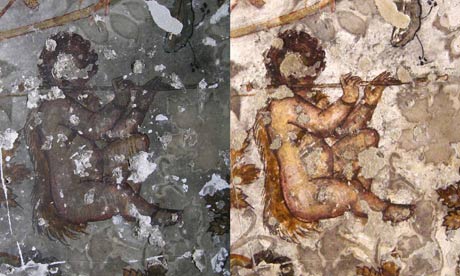
 THE third phase of the Big Dig at Brading Roman Villa may well have been one of the toughest excavations eminent archaeologist Sir Barry Cunliffe had ever undertaken but it has yielded some treasures and a greater understanding of Brading’s history up to its Roman occupation.